Industry Insights
Charting the AI Cycle of Innovation—How to Navigate the Disruption and Come Out on Top
By Ideas @ AppDirect / December 17, 2025

In this article:
Artificial intelligence stands as the fastest and most profound wave of innovation in modern history, fundamentally redefining how industries compete, economies grow, and businesses operate. To thrive in this new era, companies must understand AI’s rapid rise—and learn valuable lessons from history.
Waves of technological innovation have often sparked fear and uncertainty. From the steam engine to electricity, from the Internet to smartphones, each breakthrough compressed the timeframe for change. These advances exponentially increased productivity and triggered waves of creative destruction. As a result, industries were upended, labor markets reshaped, and societies transformed. Yet time and again, people and businesses emerged stronger, more prosperous, and better equipped for what comes next.
In this article, we explore key lessons from previous waves of innovation. By examining the patterns of technological change, disruption, and adaptation, businesses can prepare to leverage AI effectively and sustain a competitive advantage.
AI’s meteoric rise is outpacing every innovation in history
“Each wave is more time-compressed than the previous one—and the current AI cycle is forecasted to play out nearly 10 times faster than the first two industrial revolutions combined.”
—Nicolas Desmarais, AppDirect President & CEO
To fully grasp the scale and speed of AI’s impact, it helps to look beyond the headlines and reflect on past waves of innovation that have shaped history. These patterns inspire opportunity, yet also warn of disruption.
In his address to Thrive 2025 attendees, AppDirect Chairman and CEO Nicolas Desmarais highlighted two key trends among the six greatest innovation cycles in history. “Each wave is more time-compressed than the previous one—and the current AI cycle is forecasted to play out nearly 10 times faster than the first two industrial revolutions combined.”
He added that with over a billion people leveraging AI worldwide, the diffusion of AI in our society has happened faster than any other technology in human history. “From electricity to the light bulb, cars, and the Internet—you name it—nothing compares to what's happened with large language models and AI in general.”
By studying and understanding these patterns, businesses can better anticipate the challenges and opportunities that AI presents, preparing themselves not just to survive but to thrive in this rapidly evolving landscape.
What history’s greatest innovation waves teach us About AI disruption and opportunity
Innovation has always been a double-edged sword. Emphasizing that innovation rarely comes smoothly, Desmarais noted, “For these last two hundred plus years, we’ve consistently seen tension between innovation and economic hardship, with many major breakthroughs emerging during times of economic turbulence.” He added, “These lessons remind us that while innovation fuels prosperity, it also demands adaptability and resilience.”
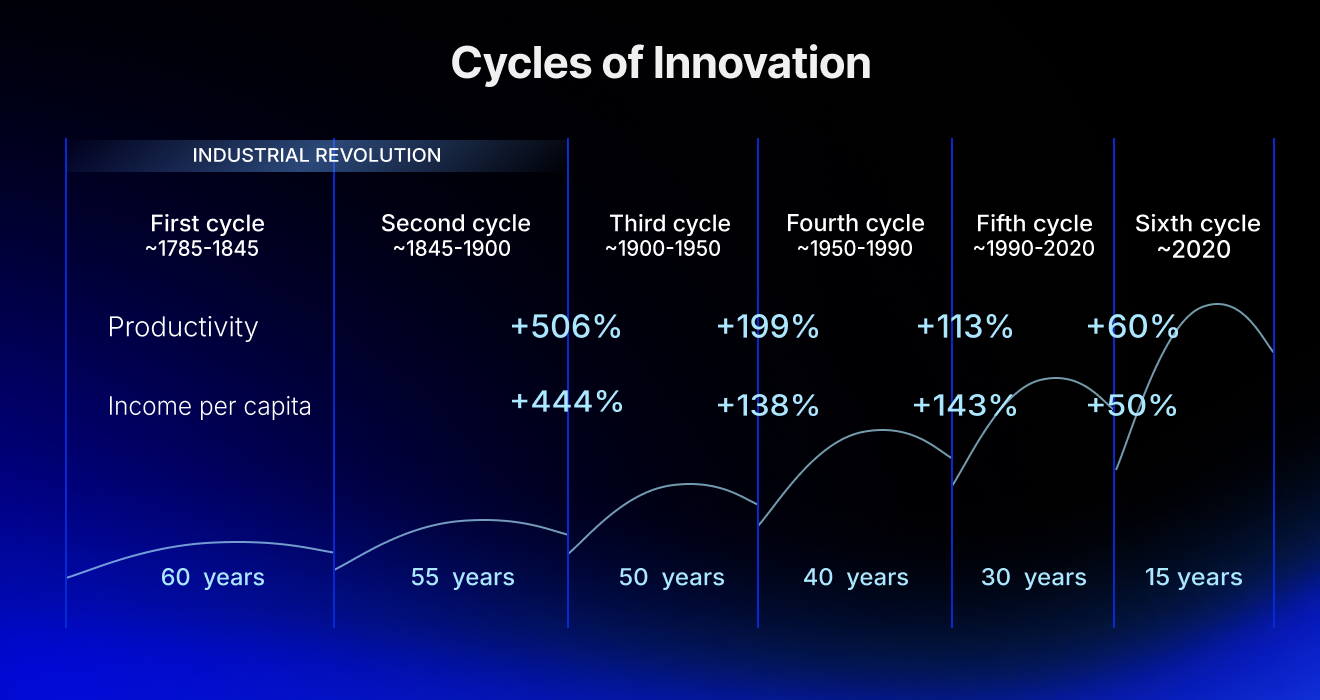
From the Industrial Revolution’s water-powered mills to the PC and Internet booms of the late 20th century, past innovation waves reveal a repeating cycle:
Rapid technological advances supercharge economic growth and productivity at unprecedented rates.
However, these advances invariably spark disruption, resistance, and uncertainty—as evidenced in the Luddites’ factory burnings in the 1800s and today’s workforce transformation concerns around AI.
Ultimately, waves of creative destruction dismantle outdated business models, paving the way for new leaders and industries to emerge.
Though disruptive, these cycles ultimately accelerate growth and productivity, creating new industries and prosperity. By learning these patterns, businesses can anticipate challenges and prepare to thrive in the rapidly evolving AI landscape.
The rise of AI—The fastest wave yet
The AI revolution we’re witnessing today is unlike any before it, both in velocity and scope. Where past innovations unfolded over decades, AI’s rapid advancements are compressing innovation cycles faster than ever, squeezing decades of change into just a few years. This acceleration is fundamentally altering how industries operate.

In business, rapid AI adoption is reshaping core processes and growth models across sectors.
“AI’s rapid advancements are compressing innovation cycles faster than ever, squeezing decades of change into just a few years.”
—Nicolas Demarais
AI performance leaps over the past 12 months
Just a year ago, humans surpassed AI on most measured capabilities, including general knowledge and coding. “Fast-forward 12 months, and this is no longer the case,” said Desmarais. “When we re-measured on the same capabilities, AI now exceeds human capability by a healthy margin on the same knowledge set. What’s more, we found that AI is orchestrating these capabilities to outperform on professional skillsets, as measured by standard tests from LSATs to CPA.”
As AI capabilities have advanced swiftly, tasks once dominated by humans—like code generation and complex problem-solving—are increasingly executed more effectively by machines.
“Even more incredibly,” Desmarais added, “in the last year AI has passed the Turing test—also known as the imitation game—developed by Alan Turing in the 1950s to objectively validate whether AI exhibited intelligent behavior and soft skills equivalent to humans. Lately, humans identified AI as human over 70% of the time, surpassing even the control group.”
An AI ecosystem explosion
The AI boom is marked by several key trends:
A surge in investment—Massive increases in investment have followed, with global AI spending soaring from under $1 billion to over $60 billion in less than five years according to Grand View Research.
An explosion of models—The AI ecosystem is exploding, growing from under 25,000 models released annually in 2021 to nearly 1 million released in 2025, empowering new applications across sectors.
Mass adoption—More than 800 million people now use AI worldwide, marking an unprecedented pace of adoption.
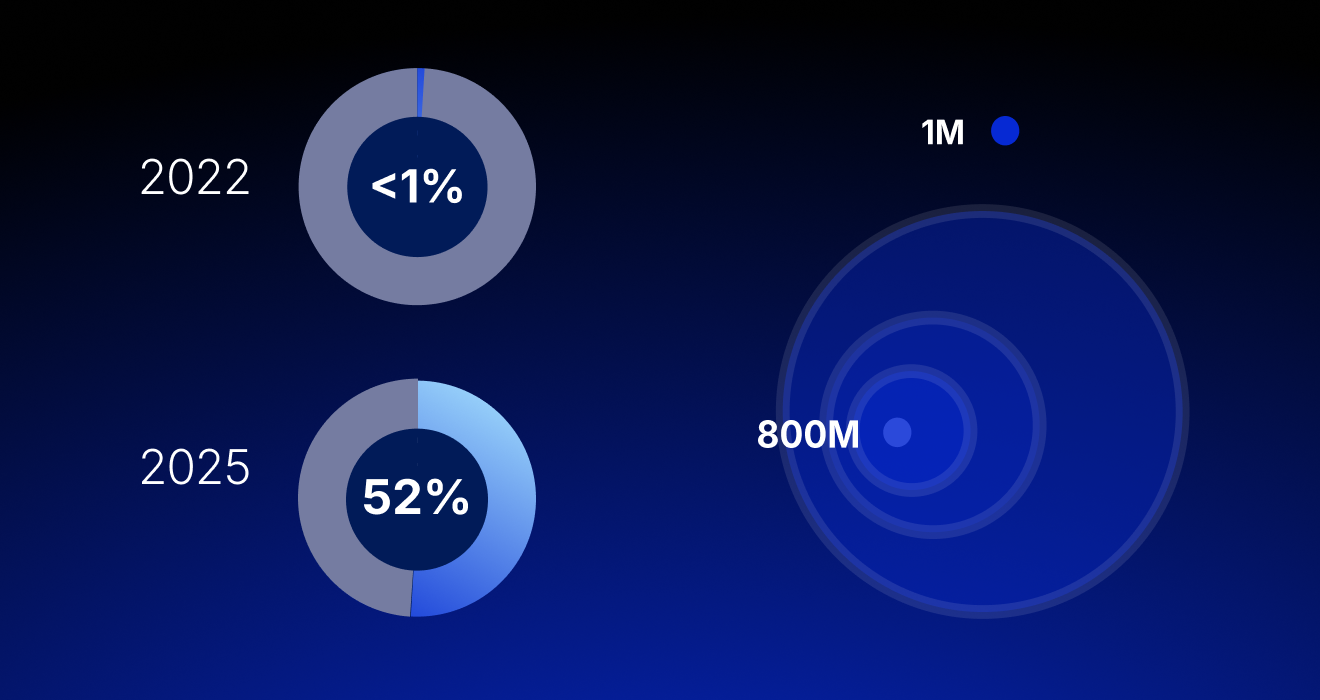
These rapid developments are reshaping productivity at historic levels.
Desmarais emphasized, “We need to go back to the Industrial Revolution to see productivity gains of this current magnitude.” Generative AI alone is expected to automate up to 30% of labor time across departments, boosting overall productivity by roughly 1.3X and freeing workers for more strategic tasks.
Generative AI alone is expected to automate up to 30% of labor time across departments, boosting overall productivity by roughly 1.3X and freeing workers for more strategic tasks.
The impact of previous waves of innovation on AI—4 lessons from the past
History offers clear strategic lessons that can guide organizations preparing for AI-driven transformation in IT and broader digital initiatives.
Here are four essential takeaways:
1. Adapt quickly or fall behind
Companies that failed to pivot during previous waves—like many in the early Internet era—were overtaken by nimble innovators such as Shopify. Desmarais noted that early AI adopters gain a competitive edge through automation, faster innovation, and scalable growth.
2. Harness digital platforms and ecosystems to scale and accelerate innovation
Digital dominance has often come from building open digital platform ecosystems—infrastructure that companies can build new products and experiences on for their customers. AI exponentially amplifies this, enabling rapid scaling, attracting developers, and expanding offerings with fewer barriers.
3. Design AI for people-first transformation
Technology succeeds when it amplifies human talent rather than replacing it. Thoughtful AI integration creates new opportunities and higher-value roles, enhancing productivity across sectors.
Build AI solutions that elevate workplace interactions and support collaboration, empathy, and usability. Prioritizing people ensures adoption, trust, and long-term value.
Explore how to build a human-centric AI strategy in a recent blog article.
4. Think long term and focus on sustainable value creation
Sustainable advantage comes from visionary investment and flexibility. Companies focused beyond short-term gains will emerge as tomorrow’s leaders in an AI-driven economy.
Preparing for the AI economy
"Navigating this transition successfully requires businesses to learn from past innovation waves and deliberately embed AI into their strategies."
The World Economic Forum forecasts significant global labor market shifts between now and 2030, predicting that while 92 million jobs may be displaced, over 170 million new jobs will be created as a result of AI. Navigating this transition successfully requires businesses to learn from past innovation waves and deliberately embed AI into their strategies.
By embracing the promise of B2B AI transformation, companies can unlock new value, foster innovation, and position themselves for long-term success.
At AppDirect, these lessons shape our approach to technology, talent, and process investment. Our goal is clear: not merely to respond to AI, but to lead the transformation of IT and B2B subscription commerce with foresight and purpose—anchored by the four pillars of digital transformation.
Actionable pathways for your AI strategy
Businesses that stay informed and actively integrate AI into their operations will capitalize on its benefits and avoid falling behind competitors who move faster and innovate smarter.
Organizations that thrive will be the ones that adapt quickly, build resilient digital foundations, and put humans at the center of AI transformation. By embracing these principles, businesses can turn disruption into a competitive edge and lead the AI-driven future.
Here are two critical paths to accelerate your AI transformation:
1. Craft targeted AI solutions to solve real business challenges
Purpose-built AI agents designed to solve specific pain points drive measurable results and sustainable advantage. Tailoring AI applications to your unique business needs delivers precision, relevance, and competitive differentiation.
Learn how to build purpose-built AI agents
2. Jumpstart your AI journey with quick wins
Rapid adaptation through focused, high-impact actions is essential. Identifying quick wins—such as automating routine tasks or improving customer experiences—builds momentum and validates investment, setting the stage for sustained AI integration.
Discover strategies for fast-tracking AI value
Access all the insights from Thrive 2025
Access all the Thrive25 keynote addresses in our Thrive resource page. You’ll also find dozens of other resources related to the Thrive breakout sessions, including presentations, customer marketing toolkits, sales guides, articles, and other content that can help you take your business to the next level.
Visit the Thrive25 resource page.
For a comprehensive look at these trends and opportunities, watch Nicolas Desmarais’ full Thrive 2025 Keynote.
Related Articles

News & Updates
The Three Reasons Enterprise AI Stalls, and How Devs.ai Clears All of Them
Your teams have been waiting for this. Devs.ai by AppDirect just expanded into a full enterprise AI platform, and what's now possible has genuinely shifted. Any team can build production-ready AI apps on their own data in days. A governed private AI store gives every employee something better than any public tool they were using before. And soon, Devs.AI will connect natively to the 2,000+ services your business already runs on. This is what enterprise AI looks like when it's built right.By Denise Sarazin / AppDirect / June 1, 2026

Industry Insights
The 4 Keys of AI Transformation—A Blueprint for AI-Driven IT
This article explores four powerful keys that will transform how your business innovates, partners, and connects with customers through AI. Packed with actionable insights, it’s your essential guide to accelerating growth, boosting efficiency, and delivering standout customer experiences.By Ideas @ AppDirect / AppDirect / December 11, 2025

Strategy & Best Practices
Fast-Tracking AI Value: Strategies for Immediate Impact
Turn AI's potential into a profit-generating reality for your business. Discover how to pinpoint impactful AI opportunities, choose the right partners, and start generating immediate value.By Denise Sarazin / AppDirect / April 8, 2026