Strategy & Best Practices
How to Unlock New Mobility Opportunities in 2026
By Denise Sarazin / February 26, 2026

In this article:
Driving real ROI for your customers
The mobility market stands at a critical crossroads in 2026, presenting technology advisors with a unique opportunity to redefine how their customers think about their mobile solutions and how they manage them. Gone are the days when leveraging carrier pricing alone was a sustainable competitive advantage With mobile plans, pricing, and promotions from carriers becoming increasingly identical, advisors can no longer rely on better rates as their primary hook.
Today, the deeper problem lies with managing the mobility spend itself. For businesses, mobile remains a fragmented, unmanaged, and expensive element of IT infrastructure. Despite significant technology advancements, mobility expenses are growing unchecked, IT teams are drowning in operational inefficiencies, and finance teams struggle with fragmented reporting and billing complexity.
Addressing this challenge in a February 2026 webinar, The superior option: Unlocking new mobility opportunities for advisors in 2026, AppDirect mobility sales expert Rob Seemann said, “Mobility is still one of the biggest unmanaged expenses out there, and one that customers need to get under control. That’s where advisors can step in and help close the gap.”
TL;DR
Mobile lifecycle management and Buyers' Club empower advisors to solve customer pain points, deliver immediate savings, and transform unmanaged mobility environments into scalable, efficient operations with enhanced visibility and analytics.
The mobile market in 2026
Several trends are accelerating the opportunity for advisors to step into this space in a bigger way. Pricing parity among carriers has diminished the value of simple plan negotiation, driving advisors to deliver higher-value services. And businesses are struggling with unmanaged expenses, IT resource waste, and mobile inefficiencies. The AppDirect 2025 IT Leaders Survey revealed that organizations manage an average of 81 vendors, with nearly half identifying service and asset monitoring as a major challenge, hindering cost control, compliance, and identifying underutilization.
In the webinar, Seeman said, “Mobility is one of the last frontiers of unmanaged IT spend. Those who step into this space now aren’t just helping customers—they’re setting themselves up to win for years to come.”
The cost of mobility chaos
For businesses, mobility management challenges often spiral far beyond simple tasks like coordinating rate plans or tracking device inventory, ultimately draining time, money, and resources in hidden ways. What may begin as a small operational task can grow into a costly, resource-heavy endeavour. Many organizations fail to fully grasp the severity of these inefficiencies until they’re pointed out, presenting advisors with an opportunity to deliver clarity and actionable solutions.
“Mobility is still one of the biggest unmanaged expenses out there, and one that customers need to get under control. That’s where advisors can step in and help close the gap.” —Rob Seemann, AppDirect
Top mobility pain points
When mobile management is fragmented or lacking, businesses face compounding issues across finance, IT, and operations.
Fragmented billing across multiple carriers—Disparate invoices make it difficult for finance teams to reconcile charges or predict costs. Managers dealing with carrier-specific portals waste valuable time and resources.
Overspending on unused mobile lines—Without visibility into active devices, businesses unknowingly pay for unused lines, often wasting significant amounts of money. Seeman pointed to one customer that was losing $1,100/day due to unused services.
Poor device inventory tracking—Without centralized tracking and analytics, IT teams resort to manually monitoring devices, creating blind spots and inefficiencies. Siloed systems, spreadsheets, and inconsistent data hinder optimization efforts.
Strained IT resources—Mobility demands often stretch IT resources thin. In one instance shared during the webinar, a full-time employee spent 90% of their bandwidth exclusively on mobile management, leaving little room for higher-priority initiatives.
Many businesses tolerate these inefficiencies simply because mobile management feels chaotic and unsolvable. As Rick Duran explained during the webinar, “When mobility feels chaotic, IT teams spend more time firefighting than building scalable frameworks. That bandwidth loss creates ripple effects across the business.”
These challenges can lead to:
Inefficient use of resources, as IT teams are forced to fight fires rather than focus on innovation or high-value projects.
Financial unpredictability, with fragmented costs result in budget overruns and missed savings opportunities.
Operational complexity, as poorly optimized plans and rigid contracts prevent businesses from scaling or adapting to changes efficiently
However, these challenges are also opportunities for advisors to deliver transformative value. By implementing lifecycle management solutions, advisors can simplify mobility, reduce waste, and optimize operations. These efforts help customers regain control, improve efficiency, and achieve measurable financial benefits.
The opportunity: People, processes, and a unified lifecycle management platform
Addressing advisors during the webinar, Seeman said: “Every customer feels like mobility chaos is inevitable—until they see how simple solutions can transform their operations.”
The good news is that organizations don’t have to remain trapped in costly, fragmented processes. For advisors, this is the moment to step in and bring clarity, simplicity, control, and cost-reduction strategies to the chaos of mobile management. By solving these pain points, they help customers save money, reclaim bandwidth, and refocus on innovation instead of upkeep.
It also presents an opportunity to diversify their recurring revenue streams and forge deeper partnerships with their customers.
“Most businesses don’t know where to start. Advisors who guide them step by step—not just on cost-savings but on long-term transformation—are the ones who earn loyalty and ongoing business.” — Rick Duran, AppDirect
Top success factors
According to Seemann, advisor success in solving their customers’ mobility challenges requires leaning in on three key pillars: people, processes, and platform.
1. People
“First, it definitely starts with people,” he explained. “We have a team of experts who become essentially an instant extension of your team, and you gain a bench of subject matter experts and analysts who manage the heavy lifting so your customers don't have to do it.”
You get access to solution engineers to ensure optimal solution designs with technical expertise in customer discovery and qualification, and solution architects who can confidently present solutions that are scoped, designed, and vetted by experts.
2. Processes
Expertise only scales if it's backed by processes, the second pillar. “We've spent over 20 years perfecting a procure-to-pay framework that automates the mundane and streamlines many of the complex things you come across with mobile lifecycle management,” said Seemann. “From procurement and ordering all the way through to invoice and payments, we've built processes and automated that as much as possible to ensure that nothing falls through the cracks.”
3. Platform
Process automation leads to the third pillar: a purpose-built platform that ensures everything is delivered with complete visibility and transparency through a single plane of glass. This lifecycle management capability enables advisors and their customers to manage the entire lifecycle of their mobility journey.
Lifecycle management: The foundation for mobility transformation
“When advisors introduce lifecycle management, they give customers control they couldn’t achieve on their own.” —Rob Seemann
Mobile lifecycle management delivers results by addressing challenges across three interconnected areas that together enable customers to manage their entire IT lifecycle: Planning and procurement, operations management, and expense management.
As Seeman explained, “When advisors introduce lifecycle management, they give customers control they couldn’t achieve on their own. It’s a transformational framework—it’s not something customers can easily replicate in-house.”
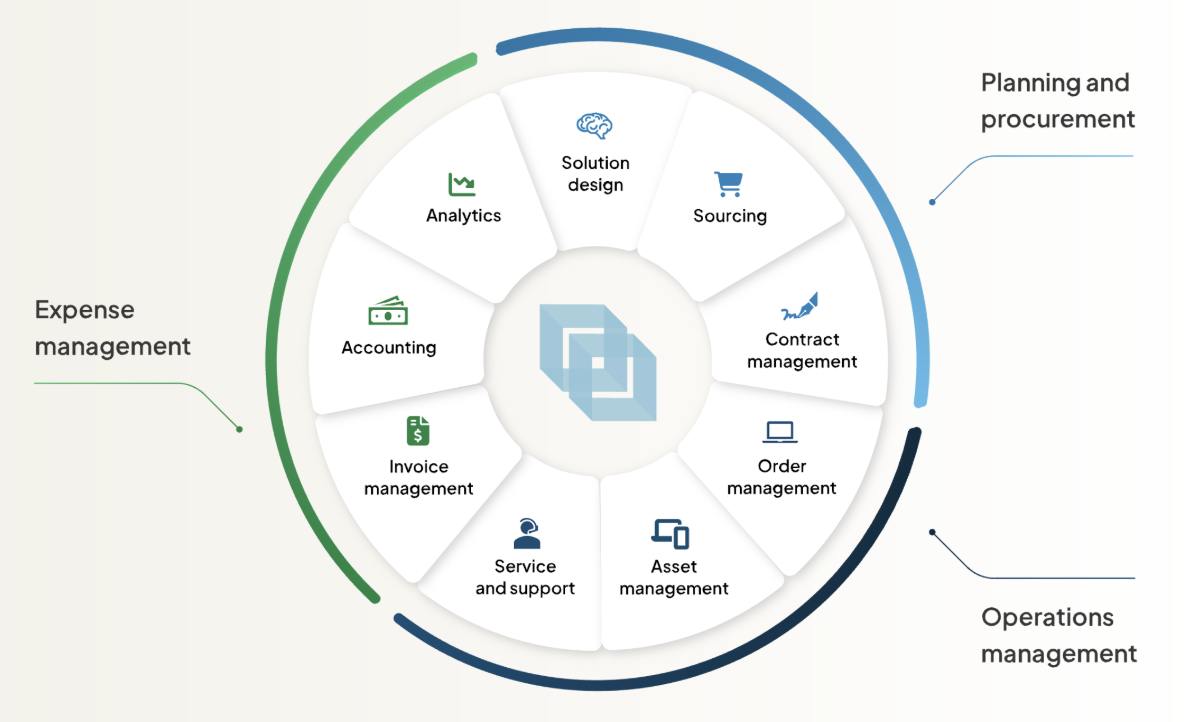
Planning and procurement—Solution design, sourcing, and contract management
Advisors add value by bringing a team of mobile experts to the table who can identify the most strategic solutions, flexible carrier rate plans, and contracts based on actual usage, as well as by offering carrier flexibility and scalability. Effective solution design and procurement eliminates overspending on services customers don’t need—or that lock them into rigid terms that limit growth.
Operations management—Order management, asset management, and service and support
The operations phase of lifecycle management provides centralized operations management tools that automate routine tasks like order management, device tracking, and service and support, and MACD (moves, adds, changes, deletes) management.
Expense management—Invoice management, accounting, and analytics
By consolidating all mobile services onto a unified platform and a single dashboard, customers get full transparency into their costs, usage, and performance metrics, eliminating hidden costs. Visibility at this level enables customers to engage in strategic planning instead of relying on reactive problem-solving.
“So you're getting the invoice management and support, even help with accounting outputs and the manual efforts that go into that, as well as, throughout the way, we're tracking all the data and analytics and providing that to you in the portal, purpose-built and automated for you,” noted Seemann.
And for advisors, Seeman added, “we have a purpose-built platform for advisors that allows you to see what activity you have going on and see insights into your customer and platform as well. So you can really become that strategic advisor.
Mobile lifecycle management benefits at a glance
Centralized asset management and automated invoice results in 20-40% cost savings and 30% increase in asset usage. With one platform and one source of truth, every vendor, contract, order, asset, ticket, and invoice in one place. This means:
Lower costs, fewer surprises—Smarter sourcing, contract management, invoice optimizations, and budget tracking.
Less manual work—Automation, expert services, and 24/7 support so your team can focus on higher‑value projects.
Clear insights—Dashboards and analytics that turn data into decisions, with 100+ reports and charts
Flexible engagement—vCom can manage what customers already have, what they buy through the platform, or purchases made via Buyers’ Club for pre‑negotiated pricing.
Built to scale—Unlimited users and integrations with customers’ existing systems.
The power of the vCom Buyers’ Club
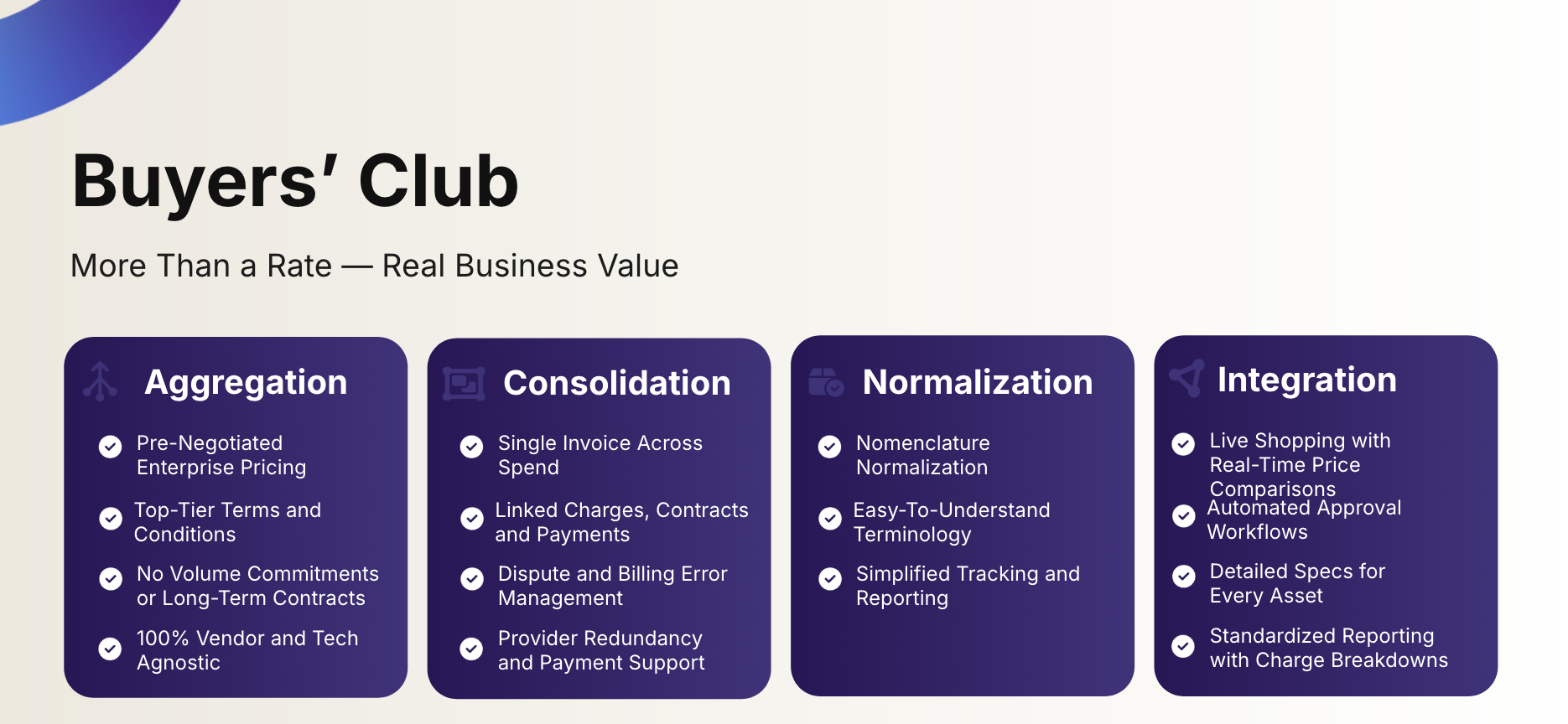
vCom, recently acquired by AppDirect, offers Buyers’ Club, providing advisors with everything needed to deliver both immediate solutions and ongoing value. The Buyers’ Club amplifies the mobile opportunity for advisors by offering added flexibility and cost savings for their customers, eliminating the inefficiencies of siloed carrier relationships, and enhancing operational flexibility.
The Four Buyers' Club pillars
1. Aggregation
Instead of one-size-fits-all contracts, customers can combine unlimited and pooled plans, adapt usage as needed, and seamlessly integrate multiple carriers to solve coverage gaps. This offers smaller customers enterprise pricing benefits, with the ability to start month-to-month from day one, without the need for volume commitments or long-term contracts.
2. Consolidation
Buyers’ Club simplifies mobility operations for customers by unifying services and systems, reducing administrative headaches and unifying billing into a single streamlined workflow. All of a customer’s carriers appear on one invoice, with one bill to process, and the platform allocates the bill accordingly. So if a customer has Verizon, AT&T, and T-Mobile, those three invoices are consolidated, with only one invoice from AppDirect to process and manage. And because AppDirect reviews all charges, customers are protected from potential service provider billing errors.
3. Normalization
On the Buyers’ Club platform, terms that can vary from carrier to carrier are standardized on the single invoice, which is vital when we're comparing carrier services like-for-like.
4. Integration
The Buyers’ Club platform provides live shopping with real-time price comparisons, so you can compare across all carriers, with full details on every asset—the device, in whose name it was ordered, location, billing details—the ability to allocate the invoice, and so on.
Buyers’ Club benefits at a glance
Right-sized plans tailored to actual usage
Seamless movement between unlimited and pooled plans with automatic optimization
Carrier flexibility, enabling customers to switch at any time
Expert support throughout the sales cycle for every customer and every opportunity
Mobile lifecycle management + Buyers' Club: A win-win for advisors and customers alike
“Customers gain freedom from rigid contracts and control over mobility chaos."—Rob Seemann.
Buyers' Club offers advisors and their customers an instant mobile department supported by experts, enabling advisors to confidently deliver enterprise-grade solutions without increasing overhead. And by embedding lifecycle management into customers' daily operations, advisors strengthen relationships, fortifying their role as strategic partners rather than transactional vendors.
Advisors benefit from evergreen residual revenue that grows in step with their customers’ evolution, and true differentiation from their competitors as experts in optimization, forecasting, and proactive mobility planning, and true partners
“Once you show customers you’re helping solve problems they didn’t even realize were holding them back, you’re no longer just selling a plan—you’re building a relationship.” —Rick Duran, AppDirect
Case study: How one customer achieved $42,000 in monthly savings
Rick Duran summarized the symbiotic relationship: “The beauty of lifecycle management isn’t just the financial savings—it’s what comes after. Customers get back control, their IT teams get back time, and they finally feel empowered to make smarter decisions going forward.”
Following is a case in point that was discussed in-depth during the webinar (access the full recording for details): a customer case study of a leading provider of home monitoring and alarm solutions that was transformed by working with vCom on its mobility challenges.
Customer challenge
The company was struggling with managing a complex mobile environment of 4,700 devices.
Limited device and mobile line visibility
Fragmented reporting made it difficult to track device inventory and manage unused lines, resulting in $1,100/day wasted on dormant services.
Process inefficiency and over-extended IT resources
Managing MACD (moves, adds, changes, deletes) manually consumed valuable time, contributing to inefficiencies across operations.
A full-time employee spent 90% of their bandwidth focused solely on mobility management tasks, leaving little room for strategic work
Solution
The customer partnered with vCom for a streamlined mobile lifecycle management approach.
Immediate visibility—With invoices loaded into the platform, vCom experts identified overspending and optimized rate plans.
Automation and support—MACD processes and financial reporting were centralized through the vManager platform, reducing manual effort.
Buyers’ Club integration—Plans were adjusted using a mix of pooled and unlimited strategies tailored to actual usage, addressing coverage gaps with multiple carriers.
Results
$42,000 in monthly savings—$20,000 saved by removing unused lines and $22,000 through better plan optimization.
Efficiency improvements—End-to-end visibility allowed proactive planning and future carrier optimizations while reducing IT resource strain.
Advisor earnings—The partner earned $7,900 in monthly commissions, with additional revenue growth as services continued transitioning.
Starting the conversation: A discovery-driven approach
“Everybody has mobile, and everybody can benefit from mobile lifecycle management” — Rob Seemann, AppDirect
For advisors, unlocking mobile lifecycle management opportunities begins with effective customer engagement. Many customers know their mobile processes are inefficient and costly, but they struggle to articulate the root causes—or where to begin addressing them.
The initial conversation is critical, setting the tone for deeper, ongoing engagement. Advisors who guide customers through discovery, rather than overwhelming them with immediate complexity, can position themselves as partners who truly understand the customer’s business needs and goals.
Rick Duran encapsulated this strategy perfectly: “Ask the right questions, listen closely, and offer something valuable upfront—it’s not about being pushy, it’s about building trust.”
Discovery questions
The right questions allow advisors to uncover hidden challenges while demonstrating genuine understanding of customer needs. Discovery conversations should align with common pain points—poor visibility, fragmented systems, and IT burnout—while positioning advisors as thoughtful partners who can offer solutions. A few examples:
How do you currently manage mobile billing across carriers?
Are unused plans or devices driving hidden costs for your organization?
Has mobile management consumed excessive IT time or resources?
Do longer contracts limit flexibility when your needs change?
How do you handle device inventory when employees leave or transition roles?
Your AppDirect Channel Manager can provide a more exhaustive list of questions and all the support you need to engage with your customers about their mobility needs.
Look for low-hanging fruit offering immediate value
Breaking through initial resistance often comes down to delivering immediate wins—the low-hanging fruit. For example, a low-pressure, no-cost rate plan review offers customers a quick, immediate look at areas where they’re over spending and where contracts could be optimized.
Duran emphasized, “Show them clear, actionable savings upfront with a rate plan review, and you earn the right to talk about the future after you solve today’s pain.”
Transitioning to lifecycle management solutions
Once you’ve addressed immediate pain points, guide customers toward broader lifecycle solutions to help customers shift from reactive problem-solving to proactive planning, including:
Lifecycle management tools to consolidate billing, manage mobile inventory more effectively, and reduce fragmentation.
Buyers’ Club participation with flexible pooled plans, carrier-neutral optimization, and scalable pricing that aligns with usage.
KEY INSIGHTS: How mobility fits within your advisor practice
Read these articles for an in-depth look at the reasons for making mobility an essential component of your advisor portfolio:
- Boost Revenues from Every Technology Deal with Proven Cross-selling Techniques
- How to Scale Your Connectivity Practice: An Advisor’s Guide
Resources to get you started
See our comprehensive mobility Customer marketing toolkit, including a pitch deck, sales guide, data sheet, co-brandable data sheet, and email template.
View the full webinar, The Superior Option: Unlocking new mobility opportunities for advisors in 2026.This hour-long video featuring Rob Seemann and Rick Duran is packed with insights, strategies, and practical tips.
To access Buyers’ Club resources and support—View our Buyers' Club web page.
Denise Sarazin is a technology writer who specializes in breaking down complex B2B topics into practical insights for technology providers, sellers, and decision-makers.
Related Articles

Strategy & Best Practices
Trapped in the Past? How Outdated Network & Mobility Management Is Costing You More Than You Think
Struggling with costly, fragmented network and mobility management? Explore how unified lifecycle management can simplify operations, reduce IT spend, enhance security, and boost agility. Get actionable insights to optimize your tech stack and stay competitive.By Ideas @ AppDirect / AppDirect / July 28, 2025

Strategy & Best Practices
Boost Revenues from Every Technology Deal with Proven Cross-selling Techniques
72% of revenues are generated from selling to existing customers, and advisors who sell into multiple categories generate 2-3X more revenues on average. Learn how to spot cross-selling opportunities and build offers that drive bigger deals.By Ideas @ AppDirect / AppDirect / August 13, 2025

Strategy & Best Practices
Grow Your Revenues Through New Routes to Market
Explore four proven strategies to broaden your routes to market, sell more effectively into the SMB market, and achieve maximum revenue growthBy Ideas @ AppDirect / AppDirect / August 21, 2025